

An update to the March 2025 analysis
In March 2025 I published “The Rising Tide of Vulnerabilities: Why Delaying Cybersecurity is a Risk You Can’t Afford”. At the time the numbers already looked stark: from 18,362 CVEs in 2020 to 40,009 in 2024 — a 118 % increase in five years.
Those figures were a warning. They were not the ceiling.
By the end of 2025, the annual total had reached roughly 50,000. According to VulnCheck’s vulnerability tracking, as of mid-November 2026, the count for the current year has already passed 100,000 — more than double the entire previous record year — and is still climbing. Across the six-year window from 2020 through late 2026, more than 280,000 CVEs have been published.
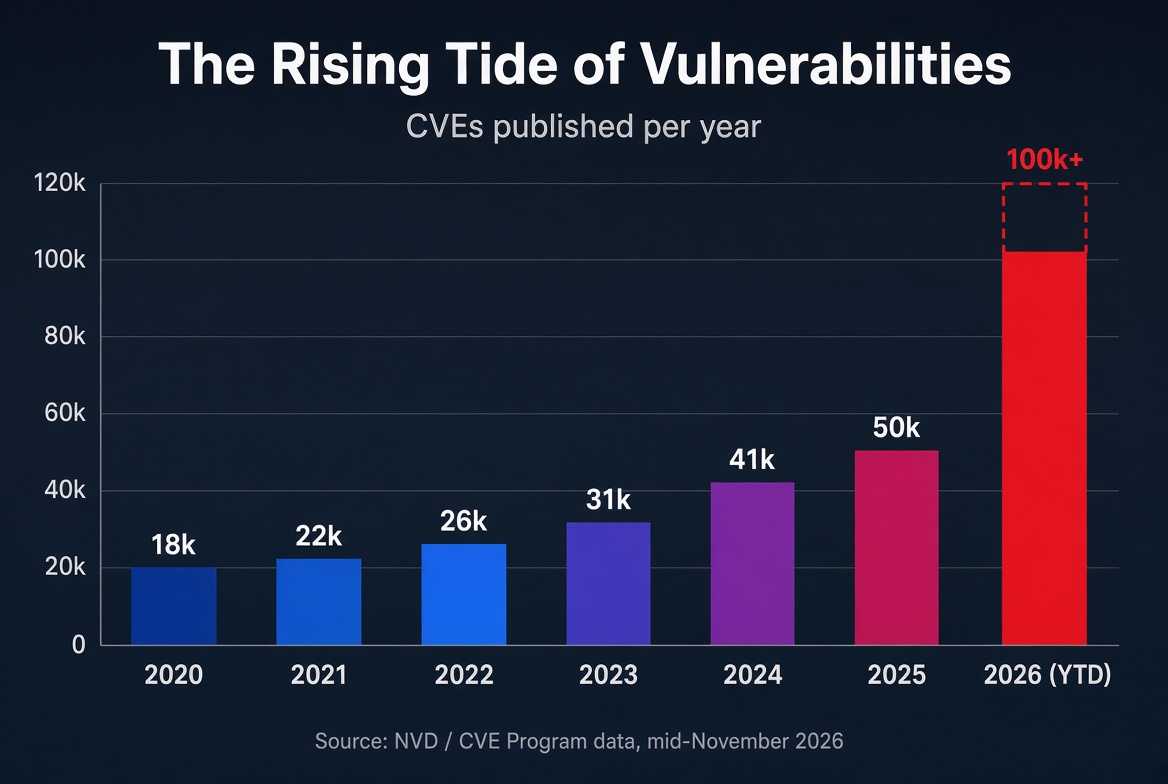
The risk is no longer merely expanding. It is accelerating, and the tools that drive that acceleration are now available to both defenders and attackers.
1. More Vulnerabilities = More Open Doors — and the Doors Open Faster
Every CVE represents a potential security exposure, but its actual risk depends on exploitability, exposure, affected assets, and the organization’s existing security controls.
In 2025 I noted that attackers were using automated tools and AI to exploit newly disclosed vulnerabilities within hours. In 2026 that observation has become routine. Public reporting from Google’s Threat Intelligence Group (GTIG) and others has documented multi-agent frameworks that continuously monitor for new patches, reverse-engineer the underlying flaw, generate a working exploit, and (in observed cases) execute it without a human in the loop. The time from disclosure to functional exploit is no longer measured in days; for many issues it is measured in hours or less.
The philosophical point remains the same. Nietzsche wrote: “He who despises himself still respects himself as one who despises.” Ignoring the integrity of the systems that run a business is not a neutral cost-saving measure. Over time, it erodes internal trust, stakeholder confidence, and customer loyalty. The difference is that the self-despising now happens at machine speed.
2. The Myth of “Too Expensive” Has Become More Expensive
The cost argument has not improved for those who delay. IBM’s 2026 Cost of a Data Breach Report puts the global average at $4.99 million — a new record and roughly 12 % higher than the prior year. The $4.45 million figure cited in the 2025 article was already outdated by the time that piece was published; the gap has widened further.
AI-enabled attacks add approximately $1 million on average to the cost of a breach. Regulatory exposure under frameworks such as GDPR and CCPA continues to reach tens of millions. Reputational damage remains difficult to quantify and even harder to reverse.
Peter Drucker’s observation still applies: “The greatest danger in times of turbulence is not the turbulence itself, but to act with yesterday’s logic.” Yesterday’s logic treated cybersecurity as a secondary concern that could be deferred. Today’s volume and speed make that logic a direct threat to continuity.
3. Delaying Means Falling Behind — and the Backlog Compounds Faster
Cybersecurity was never a project with a clear finish line. It is an ongoing process. Organizations that postponed investment are not standing still; the environment around them has accelerated.
The longer the delay:
- Systems grow more complex and interdependent.
- The unpatched backlog grows as new vulnerabilities emerge faster than organizations can assess, prioritize, and remediate existing exposures.
- The cost and operational disruption required to catch up rise accordingly.
This is technical debt in its purest form. Like financial debt, the interest compounds. Lao Tzu’s warning remains precise: “If you do not change direction, you may end up where you are heading.” For many organizations, the race is now against automated exploitation rather than human attackers using conventional tools.
4. How Companies Can Act — Even with Limited Budgets
The practical steps outlined in the original article remain the highest-leverage actions available to most organizations. They do not require a perfect program; they require consistent prioritization.
- Risk-based prioritization: Focus first on assets that are exposed and on vulnerabilities that are known to be exploited (CISA KEV) or that carry high exploit-prediction scores (EPSS). Raw volume is no longer a usable to-do list.
- Continuous monitoring and detection: Continuous monitoring, automated telemetry, and effective incident response capabilities are becoming essential to operating at the current pace of vulnerability disclosure. Technologies such as XDR and SOAR can help organizations correlate security signals, prioritize threats, and accelerate response.
- Employee training: AI-driven tools and autonomous frameworks are accelerating vulnerability discovery and exploitation, but they have not made human risk irrelevant. The 2026 Verizon DBIR reports that 62% of breaches involved a human element, compared with approximately 60% in 2025. Although this difference is not statistically significant, it reinforces the continued importance of the human factor in cybersecurity. Social engineering, phishing, credential theft, and simple mistakes remain effective ways to gain initial access. Training employees to recognize these threats and follow basic cyber hygiene practices therefore remains essential, even as automated exploitation of software vulnerabilities accelerates.
- Security automation: The same class of technology attackers are using can be turned toward defense — continuous asset discovery, prioritized patching, and automated containment.
- Shift security left: Embedding security earlier in development and operations reduces the rate at which new debt is created.
These measures do not eliminate risk. They make the risk manageable.
Final Thought: The Case Has Only Strengthened
The explosion of vulnerabilities that prompted the March 2025 article has continued, and the mechanisms driving it have become more autonomous. Ignoring cybersecurity is no longer merely frugal; it is increasingly reckless relative to the speed of the threat.
A common misconception is that modern AI systems will behave like the robots in Isaac Asimov’s stories and simply refuse to participate in harmful activity. In practice, safeguards implemented in commercial AI systems are not absolute. Determined attackers can sometimes circumvent them, exploit less-restricted models, or deploy locally hosted alternatives without equivalent restrictions. Hackers already use a combination of less-restricted local models, multi-agent frameworks, carefully framed dual-use requests, and prompt techniques to turn the same capabilities that defenders rely on into tools for vulnerability discovery, exploit generation, and automated attack. They are, in many cases, more prepared and more systematic in their use of these tools than most organizations are in defending against them.
Investing in cybersecurity is still about business continuity, customer trust, and resilience. The difference is that the margin for delay has narrowed further, and the assumption that “the AI will refuse to help” is not a reliable control. Organizations that leave known weaknesses unaddressed while automated tools search for and weaponize them are, in effect, helping to create the conditions they fear.
The original analysis was a warning. This update is a reminder that the warning was early, not exaggerated — and that the tools accelerating the threat do not come with Asimov’s Three Laws built in.